
Introduction
Two construction projects can have the same price and end very differently, and the reason is often the construction contract. It sets out how costs are measured, who carries each risk, how changes are handled, and what happens if the schedule slips. That way, you know exactly what you are paying for and can proceed with confidence.
So, it is important to understand how different contract types work. This guide breaks down the main construction contract types in Malaysia, the standard contract forms, and the practical points property owners should check before choosing a contractor.
What Is a Construction Contract?
A construction contract is a legally binding agreement that sets out the responsibilities, obligations, and terms between the parties involved in a construction project, such as the employer, contractor, architect, engineer, and other consultants. As an important aspect of construction law, these agreements help define the legal rights and obligations of each party throughout a project.
It typically defines the scope of work, project cost, payment terms, completion timeline, variations, delays and defects, giving the parties a clear reference point throughout the project. The Construction Industry Development Board (CIDB) also notes that written construction contracts can reduce uncertainty and help avoid unnecessary disputes
Why Does a Construction Contract Matter?
Construction projects have a lot of moving parts: different parties, materials, approvals, and design decisions, and many of them change along the way. Without clear contract terms, even a small disagreement can drag on because each side remembers the original deal a little differently.
As a homeowner, business owner, or procurement team, you want your contract to spell out the following:
| Contract area | What It Covers |
| Scope | What work, materials, services, and deliverables are included |
| Price | How the contract sum is calculated and adjusted |
| Payment | When and against what evidence payments are made |
| Programme | Start date, completion date and key milestones |
| Variations | How changes to scope and price are approved |
| Delays | Which events may justify additional time or compensation |
| Quality | Specifications, standards, inspection and defects |
| Risk | Which party is responsible for particular risks |
| Insurance | Required insurance and allocation of liabilities |
| Termination | Circumstances allowing either party to terminate |
| Disputes | Procedures for resolving disagreements |
The exact terms will vary depending on the contract form and your project, but these are the areas worth checking before you sign.
What Is Construction Procurement?

Construction procurement refers to how a construction project is organised and how the different responsibilities for design, construction and project delivery are allocated. It determines how the different parties work together.
Common Procurement Arrangements
1. Traditional procurement
Under traditional procurement (also known as design-bid-build), the design is generally developed by the client’s appointed consultants before the contractor is appointed to construct the works.
The client therefore has separate relationships with the design team and contractor. This can give the client greater control over design, but it also means more coordination is required between the parties.
2. Design-and-build
Design and build (also known as Design-Build (D&B)) is becoming an increasingly popular way to deliver construction projects. Under this arrangement, the contractor takes responsibility for both the design and the construction, subject to the scope and design responsibilities set out in the contract.
The appeal is simple: you deal with one main party for delivery instead of coordinating separate designers and builders.
3. Management contracting
Management contracting involves a management contractor coordinating construction works that may be carried out by separate works contractors. The management contractor’s role and payment structure differ from those of a conventional main contractor.
This approach can be useful for projects where early involvement and programme flexibility are important, but it requires strong project management and clearly defined responsibilities.
4. Construction management
Construction management is another procurement arrangement in which the client appoints a construction manager to coordinate the project while separate trade contractors may contract directly with the client.
This can provide flexibility and early package procurement, but the client generally retains more responsibility and risk than under a conventional single-main-contractor arrangement.
5. Turnkey
A turnkey arrangement places greater responsibility on the contractor to deliver a completed, ready-to-use facility, including design, construction, and other requirements specified in the contract.
Besides that, unlike design and build where you may remain more involved in design decisions, turnkey arrangements generally give the contractor greater responsibility for delivering the outcome.
6. Term contracts
A term contract is generally used where a client expects repeated works or services over a defined period rather than appointing a contractor for one isolated project.
For businesses managing multiple sites, maintenance requirements or recurring refurbishment works, a term arrangement can provide a structured way to procure work repeatedly.
7. Government procurement
Government construction projects may follow specific procurement procedures and standard forms prescribed by the relevant authority. Jabatan Kerja Raya (JKR), for example, publishes several standard forms, including PWD 203, PWD 203A, and a PWD Design and Build form.
Essential Types of Construction Contracts in Malaysia for Pricing

Once the procurement route is understood, the next question is how the construction work will be priced and paid for.
1. Lump Sum or Fixed-Price Contract
Under a lump-sum contract, the contractor agrees to complete a defined scope of work for an agreed contract sum, subject to the contract’s provisions for variations and other adjustments.
- Price certainty: Higher when the scope, drawings, specifications, and quantities are sufficiently developed.
- Best suited to: Projects where the design and scope are reasonably well defined before construction starts.
- Main advantage: The client has a clearer initial budget.
- Main risk: A fixed price does not necessarily mean the final amount can never change. Approved variations, provisional sums, adjustments permitted under the contract or other contractual mechanisms can affect the final amount.
The important question is therefore not simply whether the quotation says “fixed price”, but what exactly is fixed and what circumstances allow the price to change.
2. Measurement or Unit-Price Contract
A measurement contract bases payment on measured quantities of work completed multiplied by agreed rates.
For example, excavation may be priced according to cubic metres, while certain finishes may be priced according to square metres.
- Price certainty: Lower at the beginning if actual quantities are not yet known.
- Best suited to: Projects where quantities may change or cannot be accurately established before work begins.
- Main advantage: The client pays based on actual measured work rather than relying entirely on estimated quantities.
- Main risk: The final project cost can move as actual quantities differ from the original estimate.
3. Time and Materials Contract
A time and materials (T&M) contract pays for the labour, materials, and other agreed costs incurred, usually according to predetermined rates or mark-ups.
- Price certainty: Lower than a fixed-price arrangement.
- Best suited to: Smaller, uncertain or evolving scopes where it is difficult to define the entire work package upfront.
- Main advantage: Flexibility when the scope is not fully known.
- Main risk: The client’s final expenditure can be difficult to predict without strong cost controls, approval procedures, and reporting.
4. Percentage Rate Contract
Under a percentage-rate arrangement, the contractor’s payment is calculated using an agreed percentage applied to an underlying cost or value basis.
This structure needs to be defined carefully because the contract should establish exactly what the percentage applies to and which costs are included or excluded.
- Best suited to: Certain specialised or repeat-work arrangements where the underlying cost basis can be clearly established.
- Main risk: If the underlying cost base is not transparent, the client may have difficulty assessing the final amount payable.
5. Cost-Reimbursement or Cost-Plus Contract
A cost-plus arrangement generally reimburses the contractor for defined project costs, together with an agreed fee, percentage, or other remuneration mechanism.
This gives the contractor less exposure to certain cost uncertainties but transfers more cost risk to the client.
- Best suited to: Projects with significant uncertainty where defining a reliable fixed price at the outset is difficult.
- Main consideration: Strong cost records, audit rights, approval procedures, and clear definitions of reimbursable costs become particularly important.
In Malaysia, lump-sum and measurement-based contracts are commonly used for building projects because they provide a clearer basis for controlling costs and allocating financial risk for clients engaging in construction services.
Comparing Construction Contract Pricing Types
| Contract type | Initial price certainty | Flexibility | Main cost risk | Typical consideration |
| Lump sum | Higher | Lower | Contractor, subject to contract adjustments | Well-defined scope |
| Measurement | Medium to low | Higher | Client carries quantity uncertainty | Quantities may change |
| T&M | Lower | High | Client | Uncertain or evolving scope |
| Percentage rate | Medium | Medium | Depends on underlying cost | Clear cost basis required |
| Cost-plus | Lower | High | Client | Significant uncertainty |
Standard Construction Contract Forms Used in Malaysia
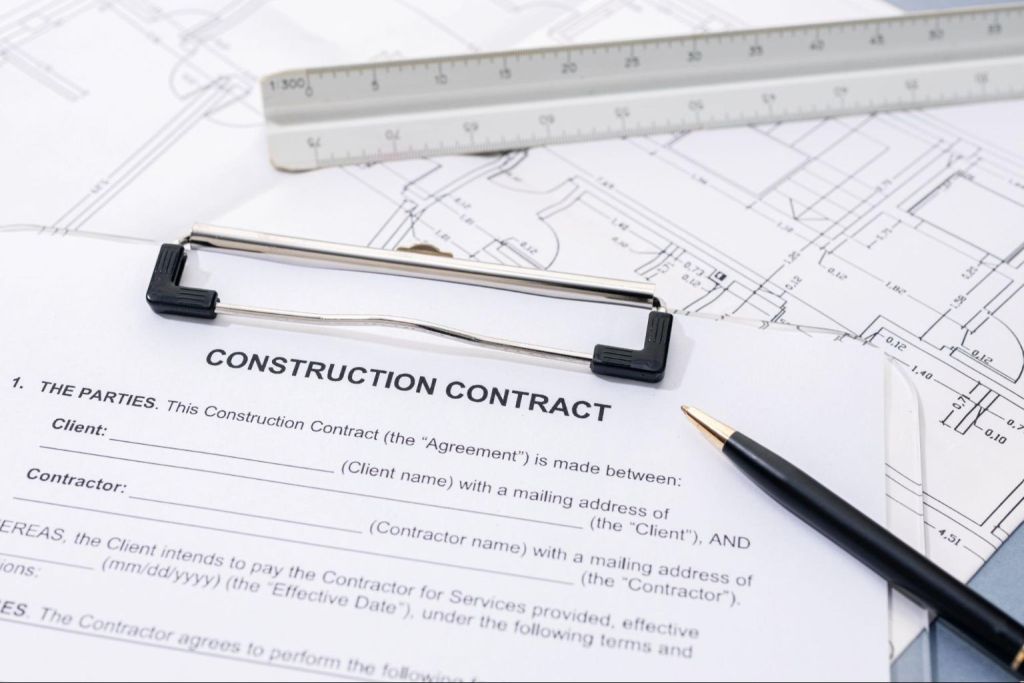
A standard form of contract is different from a pricing mechanism. It provides a recognised contractual framework that can be adapted to the particular project.
Commonly encountered forms and organisations include:
1. PAM Contracts
Pertubuhan Akitek Malaysia (PAM) publishes standard forms of building contracts commonly used in private-sector construction in Malaysia.
PAM Contract 2018, for example, contains detailed provisions dealing with matters such as commencement and completion, extensions of time, liquidated damages, payments and retention.
For a client, the value of using an established contract form is that important project-management and contractual mechanisms are documented rather than being left entirely to informal arrangements.
How Do PAM Contract Provisions & Regulations Protect A Client?
A PAM contract can establish procedures for:
- Progress payment certification
- Retention
- Variations
- Extensions of time
- Practical completion
- Defects and the defects liability period
- Liquidated damages
- Contract administration
- Insurance and other project obligations
- Dispute resolution
For example, PAM Contract 2018 provides a mechanism for liquidated damages (a pre-agreed amount payable for late completion) where the contractor does not complete the works by the applicable completion date, subject to the contract’s provisions on extensions of time.
The PAM 2018 form also provides for retention, where part of the contractor’s payment is held back during the project and released at the stages specified in the contract. This gives you additional protection if there is outstanding work or defects to be addressed.
2. CIDB Standard Contract Forms
CIDB plays a different role from a professional body such as PAM. In addition to contractor registration and industry regulation, CIDB publishes construction contract forms.
CIDB’s Standard Form of Contract for Building Works (2022 Edition) is an updated Malaysian standard form. According to CIDB, the update gives parties more ways to resolve construction issues, beyond going to court, arbitration, or mediation.
CIDB also offers the Standard Terms of Construction Contract for Renovation and Small Projects (STCC-RSP 2015). It is written in plain language for renovation and smaller projects. You can combine it with drawings, specifications, and bills of quantities to make a complete construction contract.
Why Does CIDB Registration Matter When Selecting A Contractor?
Choosing a contract type and choosing a contractor are separate decisions, but both affect your project risk.
In Malaysia, contractors must register with CIDB before carrying out construction work, subject to statutory exemptions. CIDB states that this requirement comes from Section 25 of the Construction Industry Development Board Act 1994 (Act 520), which also covers personnel competence, construction quality, and safety responsibilities.
Registration gives you a useful checkpoint, since it covers the contractor’s grade, categories, and technical personnel. A grade does not guarantee quality, but it confirms the contractor is registered and suited to the size of your project.
Want to know more about CIDB grades? Read our article on What Are CIDB Grades in Malaysia?
3. JKR Standard Contract Forms
The Public Works Department (Jabatan Kerja Raya or JKR) uses and publishes standard forms for government works.
The JKR contract library includes forms such as PWD Form 203, PWD Form 203A, and PWD Form DB for design and build. PWD 203 is used where drawings and specifications form part of the contract, while PWD 203A is used where Bills of Quantities form part of the contract.
4. FIDIC Contracts
The International Federation of Consulting Engineers (FIDIC) publishes internationally recognised standard forms for construction and engineering projects.
Some of the better-known forms include:
- Red Book: Construction contracts where the works are generally designed by the employer.
- Yellow Book: Plant and design-build contracts.
- Silver Book: EPC/Turnkey projects.
- Green Book: Short-form contracts.
For a Malaysian business, FIDIC may be relevant to your business if the project involves international parties, complex engineering work, or funding and procurement rules that call for an internationally recognised contract framework.
Quick Comparison of Construction Contract Forms in Malaysia
| Organisation | What it is | Typically used for | How pricing usually works |
| PAM | Standard building contract forms | Private-sector building projects where the architect completes the design before the contractor is appointed | Often a lump sum based on Bills of Quantities or drawings and specifications, depending on the form |
| CIDB | Malaysian standard contract forms | Building, renovation and other construction projects in Malaysia | Depends on the form or module chosen, and can include Bills of Quantities or contractor-designed work |
| JKR | Government standard forms | Government and public-sector projects, including design-and-build | Either drawings and specifications with a schedule of rates, or a Bill of Quantities, depending on the form |
| FIDIC | International standard forms | Major engineering and infrastructure projects, often with international contractors or lenders | Varies by form: Red Book for employer-designed works, Yellow Book for plant and design-build, Silver Book for turnkey delivery |
What Happens If There Are Delays in a Construction Project?
A delay does not automatically mean the contractor is responsible for every extra day. What happens next depends on why the delay occurred and how your contract deals with that situation.
Delays can happen for different reasons. For example, they may result from:
- Contractor-related issues: Poor planning, insufficient manpower or delays in carrying out the work.
- Changes to the project: Additional work or changes requested after construction has started.
- Late information or instructions: Delays in providing decisions, drawings or other information needed to proceed.
- Approvals and external matters: Delays involving authorities or other circumstances outside the contractor’s control.
- Exceptional events: Events that the contract specifically recognises as grounds for an extension of time.
The important point is that not every delay has the same contractual consequence. Where a delay falls within an event recognised by the contract, the contractor may be entitled to an extension of time, which moves the contractual completion date.
On the other hand, if the delay is the contractor’s responsibility and the works are not completed by the applicable completion date, the contract may allow for liquidated damages, which are a pre-agreed amount payable for late completion.
This is why the completion date alone does not tell you who bears the cost of a delay. Before signing, check which events qualify for an extension of time, how those claims must be submitted, and when liquidated damages can apply.
How to Choose the Right Construction Contract for Your Project

The right contract should reflect the project’s scope certainty, design maturity, risk allocation and management requirements, rather than simply the contractor’s preferred format.
1. Scope certainty: How clearly can the work be defined?
If drawings, specifications and quantities are well developed, a lump-sum arrangement may provide greater initial price certainty. If the scope remains uncertain, measurement or another flexible arrangement may be more appropriate.
2. Design responsibility: Who should control the design?
Project owners that want a single party coordinating design and construction may consider design and build. Where the client wants its own consultants to retain design responsibility, a traditional procurement arrangement may be more suitable.
3. Cost control: How predictable does the budget need to be?
Projects with a strict capital budget may place greater emphasis on price certainty and clear variation controls. A project with an evolving scope may require greater flexibility instead.
4. Risk allocation: Who can best manage each risk?
The contract should allocate risks to the party best positioned to control or manage them. Transferring every risk to the contractor does not automatically eliminate the client’s exposure. Excessive or unclear risk allocation can create pricing, claims and dispute issues.
5. Programme: How important is completion by a particular date?
For a commercial premises, factory, office or other operational facility, delays can have consequences beyond construction costs. The contract should therefore clearly establish the programme, extension-of-time mechanism and consequences of unexcused delay.
6. Administration: Who will manage the project?
Consider who will coordinate consultants, contractors, authorities, inspections, payment documentation, variations and progress reporting. A clear project-management structure can be particularly valuable when multiple trades and packages are involved.
What You Should Check Before Signing a Construction Contract

- Contractor credentials: Verify the contractor’s registration and relevant grade. CIDB registration can be checked as part of contractor due diligence. The registered grade should also be appropriate for the scale and nature of the project.
- Scope: Make sure the quotation matches the drawings and specifications. A low initial price may not be comparable with another quotation if one contractor has excluded items that another has included.
- Programme: Review the actual construction schedule. Look for realistic sequencing, approval periods, procurement lead times and dependencies rather than relying only on a single completion date.
- Payment: Understand when money becomes payable. Check deposits, progress payments, certification, retention, final payment, and any conditions attached to payment.
- Variations: Establish written approval procedures. A clear variation process reduces uncertainty when the scope changes.
- Exclusions: Identify what is not included. Authority fees, professional fees, loose furniture, appliances, external works, utility upgrades, and other items may or may not be included depending on the project.
- Contract form: Know which standard form is being used. Ask whether the project is based on PAM, CIDB, JKR, FIDIC or another form, and review any amendments or particular conditions.
- Reporting: Establish how progress will be monitored. A project timeline, site meetings and regular progress reports can provide useful commercial visibility, particularly for business premises where construction activities affect operations.
Conclusion
There is no single best construction contract as the right one depends entirely on your project. Rather than focusing only on a “fixed-price” or “lowest-cost” label, look for clear responsibilities, payment terms, realistic timelines and a clear process for changes and disputes.
Planning a design-and-build, renovation, or refurbishment project in Kuala Lumpur? Blu Mountain is a CIDB-Grade G5 interior design company offering design and build services, with structured project management, regular progress reports and clear documentation in line with applicable PAM contract requirements. You will always know where your project stands and who is accountable, from the first plan to handover. Contact our team today to get started.
Frequently Asked Questions
1. WHAT IS THE MOST COMMON TYPE OF CONSTRUCTION CONTRACT IN MALAYSIA?
The most common type of construction contract in Malaysia is the traditional (design–bid–build) lump-sum or re-measurement contract, typically administered under PAM, JKR/PWD or CIDB standard forms.
2. IS A LUMP-SUM CONTRACT ALWAYS FIXED UNTIL THE PROJECT ENDS?
Not necessarily. A lump-sum contract establishes an agreed price for a defined scope, but the final contract value can change where the contract permits variations, adjustments or other additions.
Before signing, it is recommended that you should review the variation provisions and identify what is included in the original contract sum.
3. WHAT HAPPENS IF CONSTRUCTION WORK IS DELAYED?
The contractual cause of the delay needs to be established first. Depending on the contract, certain events may entitle the contractor to an extension of time, while unexcused contractor delay may expose the contractor to liquidated damages or other contractual consequences.
PAM Contract 2018, for example, contains specific mechanisms for extension of time and liquidated damages.
4. DOES CIDB REGISTRATION GUARANTEE THAT A CONTRACTOR WILL COMPLETE A PROJECT SUCCESSFULLY?
No. CIDB registration and grading should be treated as one part of contractor due diligence, not a guarantee of project performance.
Anyone engaging with a contractor should also assess the contractor’s relevant experience, financial capacity, technical personnel, project team, previous work, proposed programme, contract terms and quality-management approach.
5. HOW CAN A BUSINESS REDUCE CONSTRUCTION CONTRACT DISPUTES?
Start by making the contract and supporting documents clear before work begins. The scope, drawings, specifications, price, payment terms, programme, variations, extension-of-time provisions, quality requirements and dispute-resolution procedure should all be documented.
CIDB also notes that written standard contracts can help reduce uncertainty and avoid unnecessary disputes.