
Introduction
Choosing a contractor takes more than comparing quotations. Behind every quote is a question that is easy to overlook: is this contractor actually registered for a project like yours? That is why checking your contractor’s CIDB grade is an essential part of due diligence for any construction or interior design and build project in Malaysia.
This guide takes you through CIDB contractor grades from G1 to G7, along with registration requirements, technical personnel, construction categories, and the PPK, SPKK, and STB certificates. It also explains grade limits, renewals, and how to verify a contractor, so you can check their credentials with confidence before you appoint them.
What Is CIDB Malaysia?
The Construction Industry Development Board Malaysia (CIDB) is the government body that regulates and develops Malaysia’s construction industry.
Under Section 25 of the Construction Industry Development Board Act 1994 (Act 520), contractors generally must register with CIDB before they carry out construction work in Malaysia, unless the Act exempts them.
What Is a CIDB Registration Record?
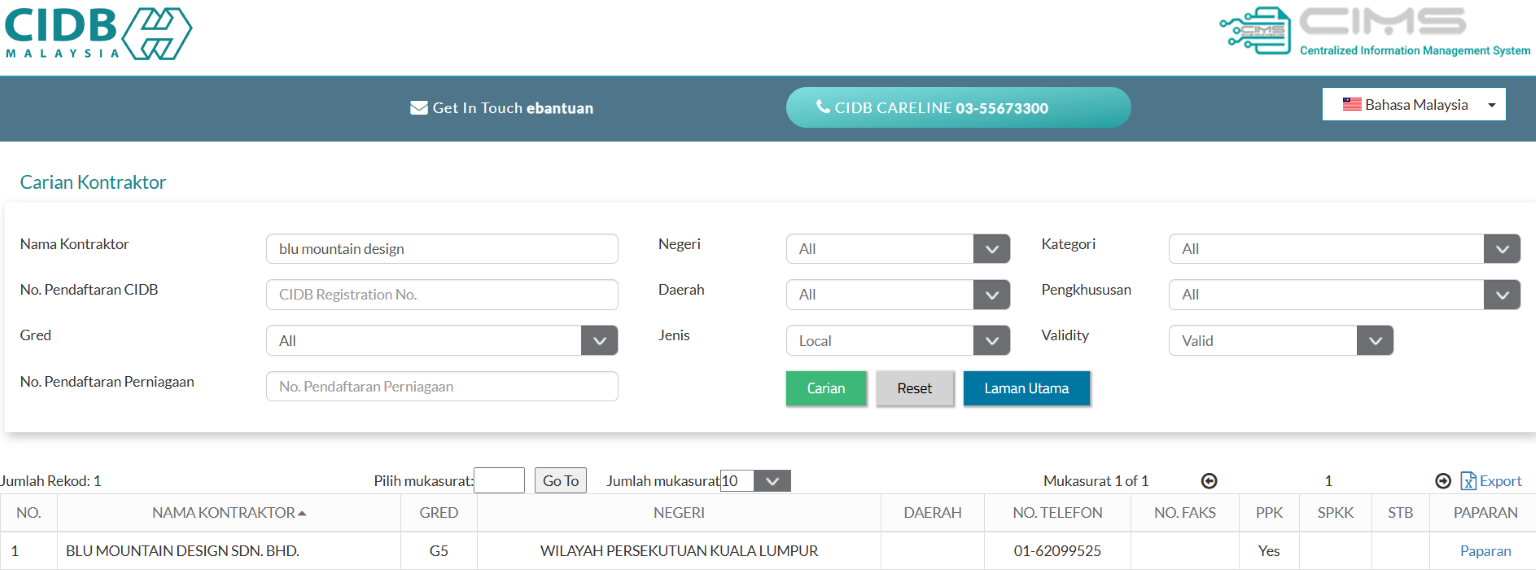
A contractor’s CIDB registration record lists its grade, construction categories, specialisations and registration validity. Together, these show what type of work the contractor is allowed to take on, and how large a project it can handle.
How Can You Verify a CIDB Contractor?
Checking a contractor’s credentials takes only a few minutes. CIDB has an online Contractor Search on its Contractors Portal, and you can look a contractor up by:
- Contractor name
- CIDB registration number
- State
- District
- Grade
- Category
- Specialisation
- Company type
Each contractor’s profile shows its current grade, registered categories, specialisations and registration status. Treat this as your number one source of truth.
What Does a CIDB Contractor Grade Mean?
A CIDB grade shows the size of projects a registered contractor is legally allowed to tender for or carry out. There are seven main grades, from G1 to G7, and each one sets a limit on the value of work the contractor can take on.
Each grade sets a ceiling on project value and comes with mandatory technical staffing requirements. It does not measure the quality of a contractor’s work or field experience. A higher grade does not mean the contractor is the best, or that it has experience across many types of work.
CIDB Grades G1 to G7: What Do They Mean?
The table below summarises the project value limits for each CIDB grade:
| CIDB Grade | Maximum Construction Value | General Meaning |
| G1 | Up to RM200,000 | Smaller construction projects |
| G2 | Up to RM500,000 | Small to lower-value projects |
| G3 | Up to RM1 million | Small to medium-value projects |
| G4 | Up to RM3 million | Medium-value projects |
| G5 | Up to RM5 million | Medium-value and larger projects |
| G6 | Up to RM10 million | Larger construction projects |
| G7 | No maximum value under the standard grade scale | Projects exceeding the G6 limit and larger-scale works |
The grade is only one part of a contractor’s CIDB registration. Contractors may also be registered under specific construction categories and specialisations, which we cover later, so the grade should always be considered alongside these details.
So, what does each CIDB grade mean in practice? Below, we break down G1 to G7 and look at what you should consider beyond the project value:
1. G1 Contractor
A G1 contractor is registered to undertake construction work with a value of up to RM200,000. This grade is generally associated with smaller-scale projects and businesses operating within a more limited project value range.
For a smaller renovation or fit-out project, a G1 contractor may fall within the appropriate registration range, provided the contractor’s registered category and specialisation match the required work.
2. G2 Contractor
A G2 contractor may undertake construction work up to RM500,000. This provides a higher project value capacity than G1 while remaining within the lower end of the CIDB grading structure.
3. G3 Contractor
A G3 contractor may undertake projects up to RM1 million under the standard CIDB grade limits. This can cover a broader range of medium-sized construction and renovation projects.
4. G4 Contractor
A G4 contractor is registered for construction work up to RM3 million. From G4 onwards, CIDB’s registration requirements include mandatory technical personnel for the relevant contractor categories.
5. G5 Contractor
A G5 contractor may undertake construction work up to RM5 million. G5 is often relevant when a project requires a contractor with a higher registered project-value capacity.
For example, a G5 contractor with building, civil engineering and mechanical & electrical registrations may have a broader registered scope than a contractor with only one category. The specific specialisations listed on the contractor’s CIDB registration remain important.
6. G6 Contractor
A G6 contractor is registered for construction work up to RM10 million. The grade requires a higher level of technical personnel and financial capacity than the lower grades.
For larger commercial, building or infrastructure projects, businesses may encounter G6 contractors as part of the tendering process.
7. G7 Contractor
G7 is the highest CIDB contractor grade and has no maximum project value under the standard grade scale.
However, G7 does not automatically mean that a contractor is the best choice for every project or has expertise in every type of construction. A G7 contractor still has to operate within its registered categories and specialisations, and the company’s actual experience and relevant capabilities should be assessed separately.
How Is a CIDB Contractor Grade Decided?

CIDB does not decide a contractor’s grade from a single assessment. Several requirements are considered together, including:
1. Project value capacity
Each grade corresponds to a maximum construction value under the CIDB registration framework.
2. Financial capacity
CIDB’s registration criteria include minimum paid-up or accumulated capital requirements. The published requirements list minimum capital of:
| Grade | Minimum Paid-Up / Accumulated Capital |
| G1 | RM5,000 |
| G2 | RM25,000 |
| G3 | RM50,000 |
| G4 | RM150,000 |
| G5 | RM250,000 |
| G6 | RM500,000 |
| G7 | RM750,000 |
These figures are registration requirements only. They do not show how much cash a contractor has available for your project, and they are not a guarantee of financial strength.
3. Technical personnel
The technical personnel requirements increase as the contractor grade increases, particularly from G4 onwards.
4. Business and company information
CIDB registration also involves company information, ownership requirements and supporting documentation.
5. Category and specialisation
The contractor must also register for the relevant construction categories and specialisations. These determine the types of construction work the contractor is permitted to undertake.
Because CIDB may review a contractor’s registration grade from time to time, the grade should always be verified using the contractor’s current registration information rather than relying on an old company profile or marketing material.
Understanding CIDB Certificates: PPK, SPKK and STB
CIDB contractor documents can be confusing because several certificates may appear together.
1. PPK: Perakuan Pendaftaran Kontraktor
PPK is the Perakuan Pendaftaran Kontraktor, or Contractor Registration Certificate.
This is the core CIDB registration for contractors. It contains important information such as the contractor’s registration details, grade, categories, and specialisations.
For general contractor verification, the PPK is therefore one of the key documents to check.
2. SPKK: Sijil Perolehan Kerja Kerajaan
SPKK stands for Sijil Perolehan Kerja Kerajaan.
It relates specifically to eligibility to participate in government construction procurement, subject to the applicable procurement requirements and conditions.
Having a PPK does not automatically mean that a contractor has SPKK. CIDB states that contractors need a valid PPK to qualify to apply for SPKK, while approval remains subject to the SPKK registration conditions.
3. STB: Sijil Taraf Bumiputera
STB refers to the Sijil Taraf Bumiputera.
This certificate relates to Bumiputera status under the applicable CIDB registration framework. It is separate from the contractor’s basic CIDB grade.
What Are the CIDB Construction Categories?
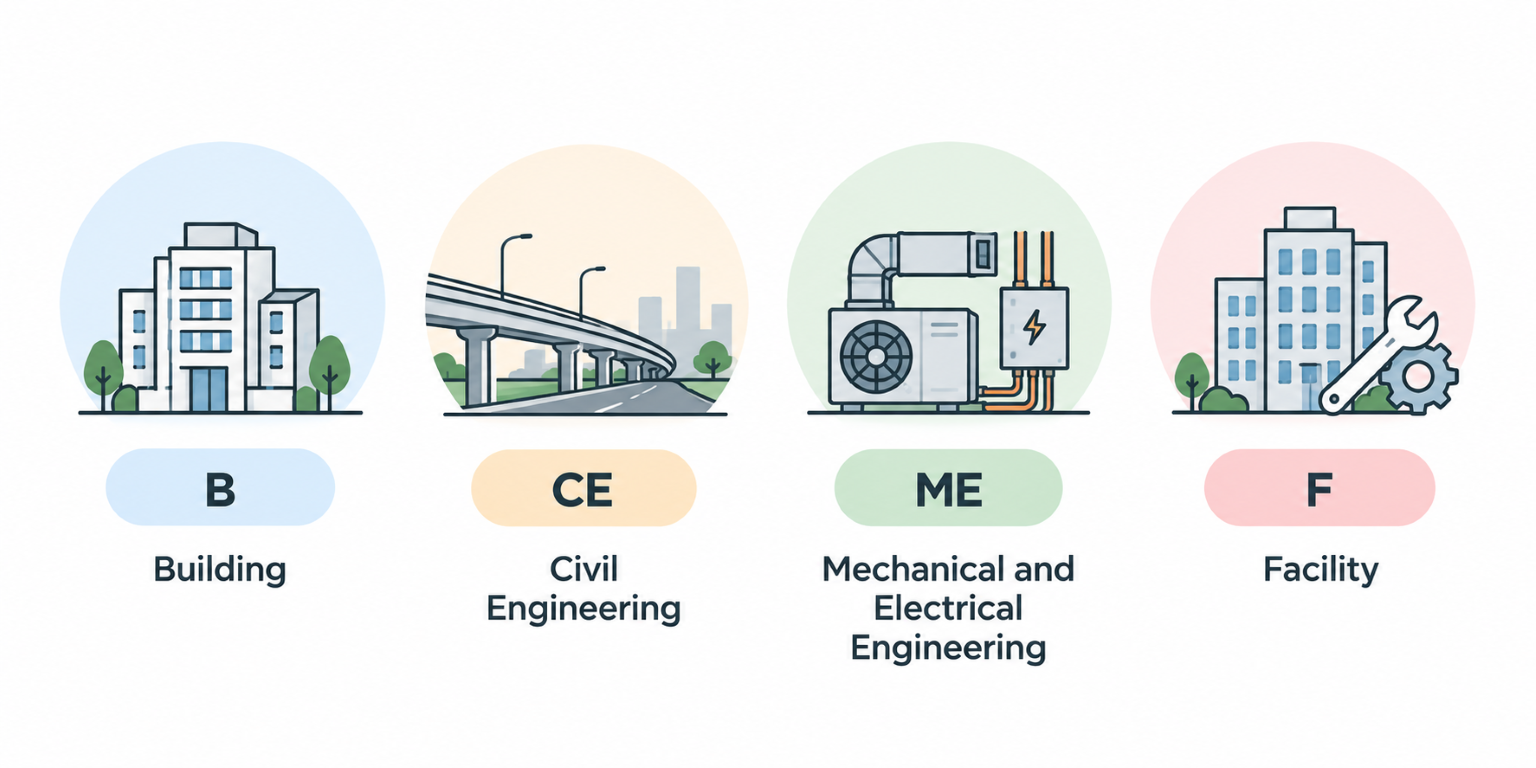
CIDB registration is not based on grade alone. Contractors can also be registered under different construction categories, including:
- B: Building
The B category covers building construction work. It is particularly relevant to building projects and can be important when appointing contractors for renovation, building alterations, fit-out and related construction work, depending on the registered specialisation.
- CE: Civil Engineering
The CE category covers civil engineering work, including areas such as infrastructure and other civil engineering construction activities.
For projects involving substantial external works, roads, drainage, structural infrastructure or other civil engineering components, the contractor’s CE registration may be relevant.
- ME: Mechanical and Electrical Engineering
The ME category covers mechanical and electrical engineering work.
This can become particularly important for commercial interior projects involving significant air-conditioning, mechanical systems, electrical installations or other building services.
- F: Facility
The F category relates to facility services and maintenance. CIDB has separate technical personnel requirements for facility contractors because the nature of facility management and maintenance work differs from conventional construction.
Categories and Specialisations: Why They Matter
Two contractors can have the same CIDB grade but very different registered capabilities. For example, two G5 contractors may both look the same on paper, but one may be registered under Building, Civil Engineering and Mechanical & Electrical categories while the other has a much narrower profile.
This matters because a project can involve many types of work, such as partitioning, ceilings, flooring, carpentry, electrical works, air-conditioning, and fire protection. So check the contractor’s registered scope against the actual work in your project, rather than judging by grade alone.
This is especially useful with a design-and-build interior design firm, because the company that designs your space is also the one responsible for building it. You only need to verify one CIDB record.
CIDB Technical Personnel Requirements by Grade
Technical personnel requirements become particularly relevant when comparing contractors because they provide an indication of the minimum technical qualifications CIDB requires for different grades.
For the B, CE and ME categories, CIDB’s published requirements specify the following minimum technical personnel qualifications:
| Grade | Minimum Technical Personnel Requirement |
| G1 | Technical Certificate, if available |
| G2 | Technical Certificate, if available |
| G3 | Technical Certificate, if available |
| G4 | 1 Diploma holder |
| G5 | 1 Degree holder with at least 1 year of experience or 1 Diploma holder with at least 5 years of experience |
| G6 | 1 Degree holder and 1 Diploma holder, with at least one having 3 years of experience |
| G7 | 2 Degree holders, with one having at least 5 years of experience or 1 Degree holder and 1 Diploma holder, both with at least 5 years of experience |
The exact requirements can differ for Facility (F) registrations, where CIDB specifies additional requirements relating to facility management and maintenance qualifications and experience.
These requirements should therefore be treated as a guide rather than a substitute for checking the contractor’s current registration details.
Why Does CIDB Registration Matter When Choosing a Contractor?

- Regulatory compliance: CIDB registration is a legal requirement for contractors carrying out construction work, subject to the exemptions under Act 520. Appointing an unregistered contractor can expose your project to regulatory and contractual risk.
- Project value capacity: The grade sets the contractor’s registered project-value limit, so you can check that it suits the value of your work.
- Technical capability: From G4 onwards, contractors must have technical personnel for the relevant categories. This is an added requirement on top of the project-value limit.
- Scope of work: The category and specialisation show whether the contractor is registered for the type of work you need.
- Workforce safety: Registered contractors are expected to appoint qualified site supervisors and skilled workers. On-site personnel generally need a valid CIDB Green Card, which involves safety training and helps lower the risk of accidents.
- Material standards: Registered contractors work within a framework that expects compliance with Malaysian Standards, which helps reduce the risk of structural failures, early deterioration, and defective components.
- Insurance and accountability: CIDB registration does not provide insurance cover by itself, but a registered contractor leaves a verifiable record. An unregistered operator may carry no public liability or workmen’s compensation insurance, so you could end up paying for damage or injury yourself. Ask to see the contractor’s policies before work begins.
What Are the Risks of the Wrong CIDB Grade?

A lower CIDB grade does not automatically mean a contractor is unsuitable. The concern is whether the contractor’s grade, category, and specialisation match the value and scope of your project.
Choosing a contractor whose registration does not match the project can create problems that extend beyond the initial appointment. The risks can include:
- Regulatory and procurement problems: A contractor working outside the scope of its registration can put your project at risk, especially when the requirements call for specific grades, categories or specialisations. If the project involves government procurement, extra requirements such as SPKK may apply too.
- Your project can be stopped mid-build: CIDB has the power to issue a written notice ordering a contractor to stop starting or continuing construction work if the contractor breaches registration requirements. This means an abrupt halt for projects that are already underway.
- Project delays and additional costs: If a contractor has to stop work, change its scope, or hand parts of the job to another contractor, expect added costs, procurement delays, and programme disruption. For commercial projects that must be operational by a fixed date, the impact can be especially painful.
- Contract and dispute complications: If your contractor isn’t properly registered or isn’t authorised for the relevant scope of work, settling arguments over delays, defects, variations or payment becomes more complicated.
- Warranty and defect concerns: When workmanship problems appear, clear contract documents and a properly registered contractor make it easier to establish who is responsible and pursue remedies. Registration alone does not guarantee quality, so your contract should still spell out defects, warranties, and rectification.
- Insurance and liability issues: Your insurance may come with conditions on who can carry out renovation or construction work. If the contractor you appoint does not meet the insurer’s requirements, such as being an approved contractor or holding the appropriate registration, you could risk losing coverage for certain losses or having a claim declined.
CIDB Contractor Registration Renewal Requirements
CIDB contractor registration is not a one-time achievement. Contractors must renew before it expires if they want to keep undertaking construction work within the scope of their registration.
Registration also has to stay current between renewals. Contractors should keep their company, technical personnel, and registration details up to date, and changes that affect the registration requirements may need to be reported or updated through CIMS.
For anyone hiring a contractor, whether a business, developer or homeowner, the takeaway is simple: check the current expiry date instead of assuming a past registration is still valid.
What Should You Look for Beyond CIDB Grade?
CIDB grade is only one part of choosing a contractor. For residential, commercial, or other projects, also consider reviewing a contractor’s:
- Relevant experience: Has the contractor completed work with a similar scope, size, complexity, or type of property?
- Programme: Can the contractor realistically meet the required construction schedule and key completion dates?
- Cost: Is the quotation detailed enough to identify exclusions, provisional sums, allowances and potential variations?
- Resources: Does the contractor have the manpower, subcontractors, equipment and project management structure needed for the work?
- Technical coordination: Can the contractor coordinate architectural, structural, mechanical, electrical and specialist works where required?
- Quality control: What processes are in place for inspections, testing, workmanship and rectifying defects?
- Safety: What site safety measures and competent personnel will be provided?
- Contract administration: Is the scope clearly documented, including drawings, specifications, programme, payment terms and procedures for handling variations?
- References: Can the contractor provide relevant completed work that can be reviewed or independently verified?
These considerations are particularly useful for interior design, renovation and fit-out work, where the outcome depends not only on the contractor’s CIDB registration but also on how effectively the contractor can translate the design into the finished space.
Conclusion
For interior design and construction projects, the right contractor is one whose registered scope and experience match your needs. CIDB grade is important, but it should not be the only thing you consider.
Planning a renovation or interior design project? Speak to us today and talk through your requirements with the team at Blu Mountain Design. We are a CIDB-G5 registered contractor, and we run every project with structured project management and transparent reporting as per PAM contract regulations. Let us help you manage the project smoothly from the first design idea through to implementation.
Frequently Asked Questions
1. WHAT DOES A CIDB CONTRACTOR GRADE MEAN?
A CIDB contractor grade indicates the maximum value of construction work that a registered contractor is permitted to undertake under its registration. The grades range from G1 to G7, with G1 covering projects up to RM200,000 and G7 having no maximum project value under the standard grade scale.
The grade does not, by itself, indicate the contractor’s experience, quality or expertise in a particular type of work.
2. WHAT ARE THE CIDB G5 CONTRACTOR REQUIREMENTS?
For the standard B, CE and ME categories, CIDB’s published requirements include a minimum paid-up or accumulated capital of RM250,000 for G5 registration and technical personnel consisting of either one degree holder with at least one year of experience or one diploma holder with at least five years of experience.
The contractor must also satisfy CIDB’s other registration requirements and maintain the applicable category and specialisation requirements.
3. CAN A CONTRACTOR CHANGE ITS CIDB GRADE?
Yes. Contractors can apply to change or upgrade their CIDB registration grade, subject to the applicable CIDB requirements and approval.
The upgrade may involve requirements relating to capital, technical personnel, company information and supporting documents.
4. DOES A HIGHER CIDB GRADE MEAN BETTER QUALITY?
Not necessarily. CIDB grade primarily relates to registration capacity and the value of construction work that a contractor may undertake.
Quality and project performance depend on additional factors such as experience, technical capability, project management, workmanship, resources, subcontractor management, quality control and compliance.
5. WHAT CIDB GRADE DOES BLU MOUNTAIN HOLD?
Blu Mountain Design Sdn Bhd is a CIDB-G5 registered contractor (PPK registration number: 0120250103-SL148683). This means the company is registered to undertake construction work for renovation and interior design projects within the project value limit applicable to the G5 grade, subject to its registered categories and specialisations.